
SERVICESAI WORKFLOWS AND SYSTEMS AI your team trusts and keeps using.
We find where your team loses hours first. Then I build the assistants and automations that win them back.
How a long list of leads becomes a ranked shortlist.
As CMO of Oodles of Doodles I built the brand a B2B lead finder with AI fit-scoring, and Insert Affiliate's AI affiliate finder works on the same idea. This is how a workflow like that runs.
DRAWN TO SHOW HOW IT WORKS
Without one, finding businesses worth pitching to is research done by hand, one search at a time.
The finder gathers the candidates from the sources you'd search yourself into one list.
AI then scores each one for fit against what your best customers have in common, so the list arrives ranked.
A person on your team reviews the shortlist and signs it off before anyone is contacted.
The approved leads go straight into outreach, in the tools your team already uses.
Most of what I build takes on the work your team repeats.
Some are assistants your team asks, some run in the background across the tools you already use, and some are products with AI inside. These are the kinds I build, with the project behind each one where I can show you.
ASSISTANTS FOR YOUR TEAM
- Assistants that answer from your own documents
- Drafts in your tone, held to your brand rules
- Assistants inside Slack, Teams or email
- Summaries of calls, threads and long reports
- Assistants for specialist work, including legal
- Onboarding help for new starters
AUTOMATIONS ACROSS YOUR TOOLS
- Enquiries sorted, routed and answered
- Data moved between systems so nobody retypes it
- Proposals and documents drafted from a form
- Reports built overnight from your live data
- Approvals that stop for a person at the right step
RESEARCH AND ANALYSIS
- Lead finding with AI fit-scoringOODLES
- Creator and partner discoveryINSERT AFFILIATE
- Market and competitor monitoring
- Answers pulled from a pile of documents
- Customer feedback sorted into themes
PRODUCTS WITH AI INSIDE
- AI features inside your own platformPLATFORMS
- Discovery and matching inside a productINSERT AFFILIATE
- Assistants your customers talk to
- Generators that turn a brief into a first draft
- Content tagged and sorted as it arrives
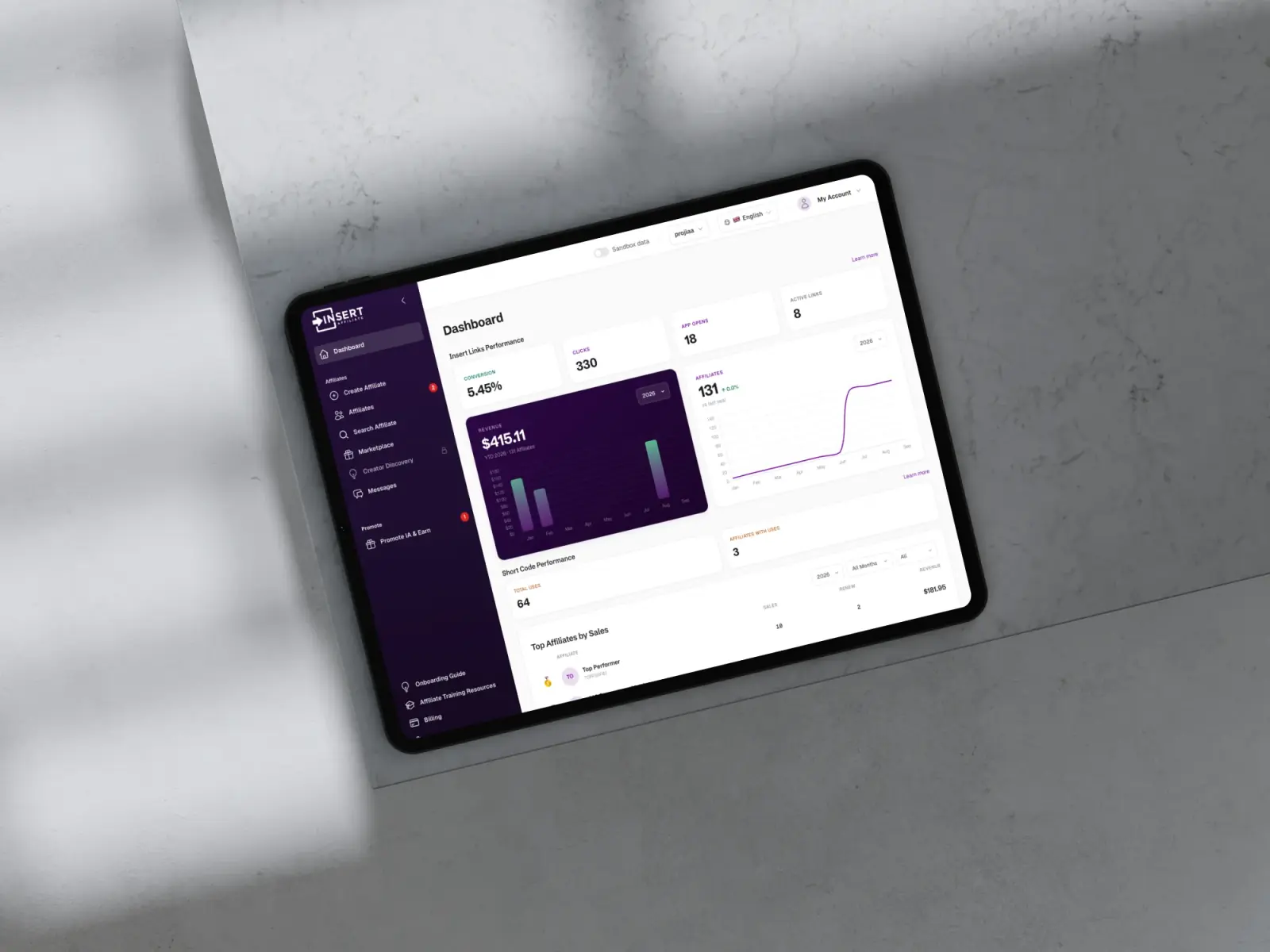
For Insert Affiliate, AI finds the creators worth recruiting.
Insert Affiliate lets iOS and Android apps run affiliate programmes, tying each in-app purchase or subscription to the creator who drove it. Before a programme earns anything, the app owner has to find creators worth recruiting.
I've worked with the team since 2025, starting with an AI affiliate finder that searches for creators and scores how well each one fits an app's programme. It sits inside the platform I went on to redesign, where app owners now recruit, track and pay affiliates from one dashboard.
READ THE INSERT AFFILIATE CASETHE AI AFFILIATE FINDER, INSIDE THE INSERT AFFILIATE PLATFORM
Your team signs off anything that matters.
Every system I build has set limits on what it can read, what it can change and what it must pass to a person. Anything that goes to a client or changes a record waits for someone on your team to approve it, and every run is logged so you can see what it did.
Then I train the people who'll use it, with a hands-on session and written guides they keep, and I adjust the system in the first weeks as it meets the cases nobody mentioned.
This suits teams who can feel where the hours go.
They can feel the time going on repetitive work, and they may have tried an AI tool or two without it sticking.
A GOOD FIT
- Someone spends hours a week moving information between tools
- You tried AI tools and the team drifted back to the old way
- You sit on documents, data or research nobody has time to read
- You want it inside the tools your team already uses
- You're an agency whose client needs AI workflows built
 Someone spends hours a week moving information between tools
PROBABLY NOT
- You want AI for its own sake, with no task in mind
- Nobody owns the process that would be automated
- You want your own model trained from scratch
Tell me the task that eats your team's week and I'll reply within a working day.
Your team is trying it on their own cases by the second stage.
Each stage ends with something your team has used or signed off, and the first workflow is kept small so it reaches them early.
Map where the time goes
I sit with the people doing the work and list the tasks that eat their week: how long each takes, what it touches and what a good result looks like. Then the tasks are ranked by the hours they cost and the risk of getting them wrong.
YOU END WITH
A ranked list of what to build, with the first workflow scoped and priced.
Build the first workflow on their cases
One workflow, built against one task in the tools your team already uses and tested on their own cases. It's small enough to ship quickly and useful enough that people notice when it's missing.
YOU END WITH
A first workflow, tested on your team's own cases.
Roll out with training and guardrails
Limits are set on what it can read and change, and anything that matters waits for a person to approve it. Each team gets a hands-on session and written guides, and I adjust the workflow in the first weeks as it meets the cases nobody mentioned.
YOU END WITH
A team that uses it without being reminded, with every run logged.
Measure and extend
We compare the workflow against the time the task took on the map, then build the next one on what the first taught us, monthly on a retainer or as a separate project.
YOU END WITH
The first workflow measured, and the next one scoped.
The map is short, and the first workflow is scoped small on purpose so your team is using it as early as possible. Its timeline and fixed price are set in writing before anything is built.
Built so the model can be swapped when a better one arrives.
The models change every few months, so each workflow is built to move to a better one without starting again. Every system I build comes with these three things.
- Your data, kept yours Systems run on accounts in your name, on the business tiers of the models, which don't train on what you send them. Access is set per person.
- A person signs off Each system has set limits on what it can touch, someone on your team approves what matters, and every run is logged.
- Measured against the map Each workflow is checked against the hours its task took before, so you can see what it's worth before the next one is built.
WHAT IT RUNS ON
- Claude
- For drafting, reasoning and reading long documents, and the model behind the system I built for legal work.
- Gemini
- When it suits a task better on quality or cost, or your team already works in Google Workspace.
- Supabase
- When a workflow needs its own database, document store or dashboard, in an account you own.
- Automation tools or code
- Whichever runs a workflow more reliably and is easier for your team to look after, wired into Slack, Teams, email or your CRM.
You get a fixed price for the first workflow before anything is built.
IN AN AI WORKFLOW PROJECT
- A map of where your team's time goes
- A ranked list of what to build first
- The workflow built in the tools your team uses
- Answers grounded in your own documents and rules
- Set limits on what it can read and change
- A person's sign-off wherever it matters
- A log of every run
- A hands-on session and written guides for each team
- Adjustments in the first weeks of use
I price after the map, because the cost depends on which task comes first and what it touches. The scope, the timeline and the fixed price come in writing with the reasoning shown, and the price holds for that scope.
The accounts, the API keys, the prompts and the code are in your name from the start, with no licence fees to me.
Once it's live, a monthly retainer works down the rest of the list, or your own developers can take it on with the documentation.
Three ways to work with me
PROJECT
One workflow, start to finish
A workflow with a clear scope and a fixed price, from mapping the task to your team using it on live work, trained and with guardrails in place.
RETAINER
The next workflow, each month
Reserved days each month work down the list: new workflows, updates as better models arrive, and training as your team grows.
FOR AGENCIES
AI work for your clients
I work inside your process as the AI and build partner on your clients' workflows, white-label or credited, by project or by month.
What people ask before the first call
If yours isn't here, ask it in your first message.
TRUST AND DATA
Is our data safe?
Everything runs on accounts in your name, on the business tiers of the models, which don't use your data for training. Access is set per person, and anything sensitive stays in systems you control. If a task involves data that can't leave your own systems, we design around that from the start.
What if the AI gets something wrong?
Sometimes it will, so every system is built for it. Anything that matters goes past a person before it goes out, every run is logged, and the instructions are tightened whenever a mistake turns up.
Will it replace people?
I scope the work around the repetitive part of jobs your team already does, so the same people get hours back for the parts that need them. Where a system acts on its own, a person still signs off on what matters.
COST AND TIME
What does it cost?
I price after the map, once we know which task comes first and what it touches. Every build has a fixed price in writing with the reasoning shown, and ongoing work can sit on a monthly retainer.
How long does the first workflow take?
It depends on the task. The map is short, and the first workflow is scoped small on purpose so your team is using it as early as possible. You get a written proposal with the scope, the timeline and a fixed price before anything is built.
WORKING TOGETHER
Which AI do you build with?
Mostly Claude and Gemini, chosen per task for quality, cost and where your data has to stay. Each system is built so the model can be swapped when a better one arrives.
Do we need technical people in-house?
You don't. I build, host and document each system, so your team only needs to use it. If you have developers, they get the code and the documentation and can take it on.
Do you work with agencies?
Yes, as the AI and build partner inside your process on your clients' workflows, white-label or credited, by project or by month.
Who owns what you build?
You do. The accounts, the API keys, the prompts and the code are in your name, with no licence fees to me. If we stop working together, everything keeps running in your accounts.
Which task eats your team's week?
Tell me the work that repeats and who does it now. The first step is a thirty-minute call about where the hours go.
CURRENTLY AVAILABLE FOR NEW PROJECTS